Once again, we are pleased to announce two new winners of the Humboldt Innovation Award.
In 2025, the Dissertation Award goes to neuroscientist Barbara Hollunder, while the Bachelor/Master Award is presented to physicist Daniel Kohl.
The Humboldt Innovation Award honors those who, in their final theses, demonstrate the vital role of university research in driving applications in business and society, thereby laying the groundwork for innovative products and services.
Dissertation by Barbara Hollunder
Barbara Hollunder completed her dissertation at Charité – Universitätsmedizin Berlin under the title “Brain Stimulation as a Window into Architecture and Therapeutic Potentials of the Human Dysfunctome.”
In her research, Hollunder investigates the use of deep brain stimulation (DBS) to identify and selectively modulate dysfunctional neural networks in the brain. This neurosurgical procedure, in which fine electrodes are permanently implanted, makes it possible to visualize and therapeutically target symptom-relevant networks in various psychiatric and neurological disorders.
In an international multicenter study, characteristic network profiles were identified for obsessive-compulsive disorder, Tourette syndrome, Parkinson’s disease, and dystonia, and their clinical relevance was confirmed. The results showed that therapeutic success increased the more precisely DBS modulated these networks.
“In the long term, this approach could initiate a paradigm shift in neuromodulation therapy—from standardized ‘one-size-fits-all’ methods toward a personalized, network-based treatment of individual symptom patterns,”
(from the dissertation review). The dissertation was supervised by Prof. Dr. Andreas Horn, with Prof. Dr. Carsten Finke and Prof. Dr. Andrea Kühn serving as co-supervisors.
Master's Thesis by Daniel Kohl
In his master’s thesis, “Design and Characterization of a Miniaturized Two-Photon Frequency Reference Utilizing Rubidium MEMS Cells,” completed at the Department of Physics at Humboldt University, Daniel Kohl develops a compact optical frequency reference system based on rubidium vapor cells using MEMS technology.
The goal of his work is to transfer highly precise time and frequency standards into a miniaturized, energy-efficient format, thereby bridging the gap between laboratory precision and practical applicability.
The system combines a spectroscopy module with interchangeable MEMS cells and a laser system based on a chip-scale extended-cavity diode laser. Kohl investigates different cell types and bonding techniques, finding that anodically bonded cells perform best: they exhibit narrow linewidths down to 3.45 MHz and stable operation over several weeks. Through active stabilization of temperature, optical power, and residual amplitude modulation, the system achieves a short-term frequency instability of about 2.8×10⁻¹²/√Hz and long-term stability values below 10⁻¹³.
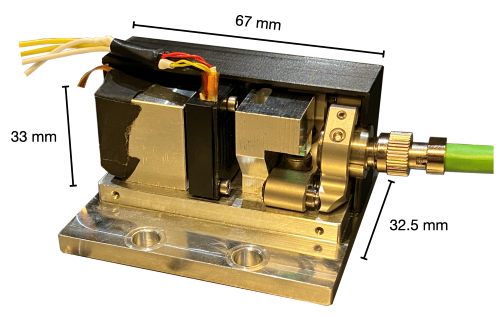
The thesis demonstrates the technical feasibility of compact, MEMS-based optical frequency references with high stability. It makes a valuable contribution to the advancement of miniaturized atomic clocks and opens new perspectives for applications in navigation, telecommunications, space research, and precision metrology.
Both theses impressively illustrate how fundamental research and technological innovation intertwine.
While Barbara Hollunder opens new pathways toward personalized, network-based neuromodulation, Daniel Kohl shows how ultimate measurement precision can be translated into compact, practical systems. Together, they exemplify the shift toward individualized, application-oriented solutions in modern neuroscience and physics research.
The official award ceremony will take place on November 12, 2025, in the main building of Humboldt University (Unter den Linden 6, Berlin).